
UK Abortion Laws
August 29, 2025
When Did At-Home Abortion Pills Become Legal in the UK? (2022–2025)
On 30 Aug 2022, abortion pills at home became permanently legal in England & Wales. Three years on, we explore safety, access, and what’s next.

Written by
Dr. Aka (GMC Number: 4275695), Medical Director at Top at Home

Reviewed by
Dr. Ohizua (GMC Number: 4446275), Consultant Gynaecologist at Top at Home
Last Updated: August 29, 2025
Quick Summary
- On 30 August 2022, at-home early medical abortion (EMA) became permanently legal in England and Wales.
- Women up to 9 weeks + 6 days pregnant can take both abortion pills at home after a remote consultation.
- Since then, over 450,000 women have accessed pills by post, with 61% of all abortions in 2022 carried out at home.
- Evidence shows it is safe, effective, and preferred by many, especially women in vulnerable or hard-to-reach situations.
But concerns remain around oversight, coercion screening, and uneven access, as well as ongoing debates on full decriminalisation.
When Did At-Home Abortion Pills Become Legal in the UK?
At-home early medical abortion (EMA), using both mifepristone and misoprostol after a remote consultation, became permanently legal in England and Wales on August 30, 2022. This followed temporary measures during COVID-19 and a parliamentary vote earlier in the year.
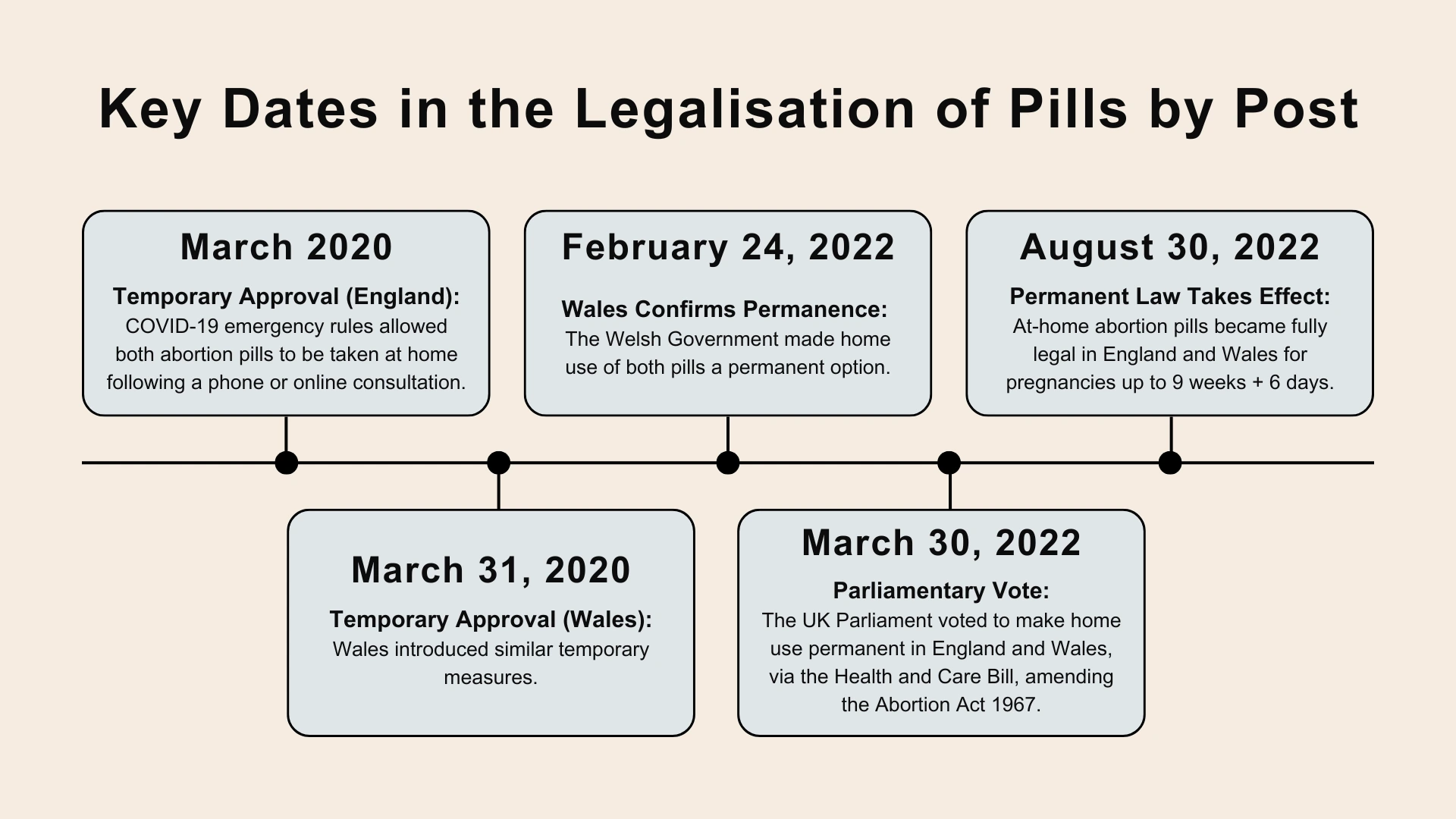
Key Dates in the Legalisation of Pills by Post
- March 2020 - Temporary Approval (England):
COVID-19 emergency rules allowed both abortion pills to be taken at home following a phone or online consultation.
- March 31, 2020 - Temporary Approval (Wales):
Wales introduced similar temporary measures. - February 24, 2022 - Wales Confirms Permanence:
The Welsh Government made home use of both pills a permanent option. - March 30, 2022 - Parliamentary Vote:
The UK Parliament voted to make home use permanent in England and Wales, via the Health and Care Bill, amending the Abortion Act 1967. - August 30, 2022 - Permanent Law Takes Effect:
At-home abortion pills became fully legal in England and Wales for pregnancies up to 9 weeks + 6 days.
What Changed on 30 August 2022?
On this date, the UK government amended the Abortion Act 1967, permanently allowing women up to 9 weeks and 6 days pregnant to:
- Receive a remote consultation with a qualified doctor.
- Take both mifepristone and misoprostol at home.
- Avoid mandatory clinic visits that were previously required.
This legal change built on emergency pandemic measures and shifted abortion care closer to a patient-centred model, removing barriers of travel, time, and stigma.
How Many Women Have Used “Pills by Post”?
- Between spring 2020 and August 2022, over 150,000 women used telemedicine abortion.
- In 2022 alone, an estimated 153,000 women (61% of abortions) used pills by post.
- By 2023, NHS data showed abortions rose to 271,000 (up 8%), with telemedicine as the driver.
- Projections for 2024–2025 suggest more than 300,000 abortions annually, with home use the majority pathway.
In numbers: More women than ever are accessing abortion earlier, safer, and with greater privacy.
Who Has Benefited Most?
- Women in abusive or controlling relationships
Telemedicine increases disclosure of safeguarding issues during private phone calls. - Students, carers, and those without transport
Pills by post allow discreet access without arranging travel or childcare. - Women in deprived or rural areas
Studies show the strongest impact among groups previously facing long wait times or poor access.
Is It Safe? What the Evidence Shows
- High success rate: Studies of over 50,000 UK cases confirm >98% effectiveness, with <0.05% serious complications.
- Patient preference: In one study, 83% preferred telemedicine, and 66% said they would choose it again.
- Hospital treatment rates: Around 6% required additional clinical support - consistent with expectations for medical abortion generally.
In short: outcomes are comparable to, or better than, in-clinic care.
.webp)
What Do Women and Providers Say?
“Without a doubt, this is the way forward.” - Participant in the SACHA Study (LSHTM, 2021)
- Women’s experiences: Stories like Lily’s (41, mother of two) show how pills by post provided relief, privacy, and autonomy. Academic studies echo this, with most participants reporting telemedicine as supportive and empowering.
- Clinicians: According to MSI UK’s 2023 report, remote consultations led to more safeguarding disclosures - particularly around domestic violence and coercion - thanks to the privacy of phone or online appointments.
- Researchers: A study by LSHTM (Aiken et al., 2021) found telemedicine reduced wait times (from 10.7 days to 6.5 days) and meant abortions occurred earlier in pregnancy - 40% before 6 weeks, compared to 25% in clinic pathways.
What Do Advocacy Groups Say?
- BPAS & MSI UK: Welcomed permanence, citing NHS savings (~£3m/year), faster access, and reduced stigma.
- RCOG: Former president Dr. Ranee Thakar called for decriminalisation after cases like Carla Foster, stressing healthcare - not punishment.
- Right to Life UK: Continues to raise concerns around gestational-age verification and potential misuse, pushing for stricter oversight.
What Challenges Remain?
- Legal uncertainty: June 2025 saw MPs vote to decriminalise abortion for women, but the reform still awaits final approval.
- Oversight: Parliamentary reviews are exploring ways to improve safety checks, remote verification, and coercion prevention.
- Access gaps: Some regions still face a “postcode lottery,” with language and digital access barriers. Policy and tech innovation remain urgent priorities.
- Public debate: Cases like Carla Foster (2023) and Nicola Packer (2025) highlight the human cost of outdated criminal statutes.
What Does This Mean If You Just Found Out You’re Pregnant?
If you are under 10 weeks pregnant in England or Wales, you can still legally:
- Book a same-day virtual consultation with a GMC-registered doctor.
- Receive MHRA-approved pills by discreet tracked post within 24–48 hours.
- Be supported before, during, and after by medical professionals.
📘 [Learn more about pills by post]
In Summary
Three years on from the August 30, 2022 decision, telemedical abortion has:
- Improved access and reduced delays.
- Enabled safer, earlier care for hundreds of thousands of women.
- Reduced pressure on clinics and cut demand for unsafe alternatives.
But challenges remain: ensuring equitable access, safeguarding vulnerable women, and finalising legal protections through decriminalisation.
At Top at Home, we believe abortion is healthcare, not a crime - and we are committed to safe, discreet, compassionate pills-by-post care.
FAQ
Q1: Is abortion now legal at home in the UK at any time?
A: No. Pills by post are legal only up to 9 weeks + 6 days, following consultation.
Q2: Does this apply in Scotland or Northern Ireland?
A: No. Current rules only cover England and Wales.
Q3: Is telemedicine abortion safe?
A: Yes. Large UK studies show >98% effectiveness and very low complication rates.
Q4: Can you be prosecuted for using pills by post?
A: As of June 2025, MPs voted to remove criminal penalties for women - but full legislative approval is still pending. 👉 Read more about the UK abortion ruling and what it means.
Q5: What changed with abortion laws in 2022?
A: The change made permanent the ability to take both abortion pills at home after a teleconsultation. Before the pandemic, only the second pill (misoprostol) could be taken at home; the first (mifepristone) had to be taken in a clinic.
Q6: Are abortion pills legal in the UK?
A: Yes. Abortion pills (mifepristone and misoprostol) are legal in the UK under the Abortion Act 1967, provided medical criteria are met. In England and Wales, both pills can be taken at home under 10 weeks after a doctor consultation. Scotland and Northern Ireland have different rules.
MEET TOP AT HOME

%20low-sensitivity%20pregnancy%20test.webp)

%20(4).webp)